
The Three Hares

The Three Hares is an enigmatic and ancient symbol, which according to leading expert Dr Tom Greeves ‘ in so many places was given overtly special status or sacred status, as the centrepiece of Buddhist caves in Dunhuang, or on an Islamic coin, or cast into one of the finest bells in Christian Europe, … [and] almost certainly used on different levels and meanings… Today we are free to interpret [its meaning]. ’ The symbol features three hares running or crouching in a Strange Loop, with the ears of each hare shared by another. Potentially its earliest depiction (dated 1CE/BCE or alternatively a Volder or neoclassical replica) has one hare running and the others crouching, as depicted on the bottom of the Seine Cup [figure 1].[1]
According to Three Hares expert Michel Terrier, 81.3% of Hares in England are turning counter clockwise [while] 80% of Chinese hares turn clockwise.[2] While some believe the rabbits symbolize eternity… [or] fertility, others consider them a representation of the connection between the heavens and the earth.[3] For William Wotton and Browne Willis in 1716, the meaning of the three hares by then was lost.[4]
A Noahite interpretation (2022) of the symbol

Inspired by a Judaic outer message presented by פטר חמור and subsequent framework identifications, on 18 April 2022 WikiNoah contributor המשיח הוא יהדות presented a Noahite interpretation of the Three Hares symbol on the Red Judaism (now Bei Abidan) YouTube channel, alongside פטר חמור and Eric the Great.[5] The interpretation is labelled such given it works from a Judaic reference point and extrapolates relevant meaning via a combination of consistent markers and theological (self-)references into academic scholarship. In addition, symbological references related to the Auxerre Manuscript [figure 2]; first published in the 13th Century and brought to public attention by Michel Terrier, are highlighted green. Using this interpretation, a higher-level correspondence is identified, lending credence to Wotton and Willis’ claim of a potential core meaning.
Judaism

• According to Judaism, ‘ the hare—although it chews the cud, it has no true hoofs: it is impure for you ’[6], and this is understood as a spiritual, not physical concept.[7] Regarding the image of the eagle grasping two hares as it existed in several (former) Ukrainian synagogues, Bracha Yaniv connects the hares to the Greek Kingdom considered hostile to "the people of Israel"[8]; Elliot Horowitz however identifies the verse of Deuteronomy 32:11 surrounding the image [from Chodorow synagogue] as suggesting the eagle is lifting the hares to rescue them from danger.[9] A similar interpretation [to Horowitz] is given by Boris Khaimovich, who sees it ‘ as a metaphor for the Almighty exercising dominion over his G-d-fearing people or as metaphorical representation of the relationship of the righteous man (or "the people of Israel") with G-d. ’[10]
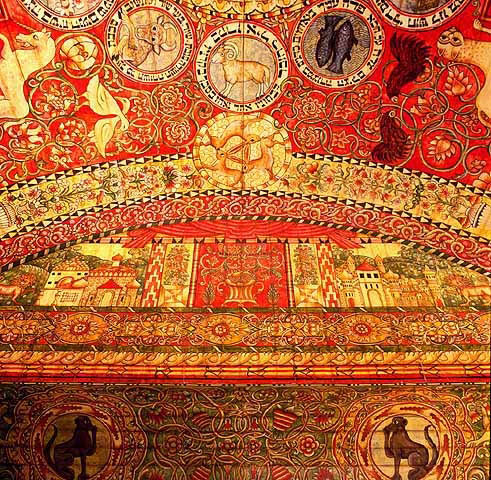
• Related instances of the three hares are found in Ukraine and particularly Podolia[11], which acted as a cultural bridgehead via which the Messianic tension of the Sephardic Jews in the Ottoman Empire was transferred to Eastern Europe.[12] Figure 3 shows one such example, which has been carefully reconstructed in Beth Hatefutsoth museum, Tel Aviv, from (the former) Chodorow synagogue.
• According to Dr Boris Khaimovich, who is described as one of the most important and insightful researchers into Jewish gravestone epitaphs and iconography[11], ‘ on some monuments the motif of the “three hares” paradoxically replaces the “three overlapping fish”. Such a representation would seem to be possible only if they are identical semantically and contextually. The image of “three fish” on an eagle’s breast… can be interpreted as a metaphor for Shekhinah which rests on righteous men. ’[13]
• Dr Khaimovich references Jewish art historian Rachel Wischnitzer in stating ‘ Apparently, these or similar texts once gave [her] reason to believe that the three [overlapping] fish pictured on a platter for Purim, from Bamberg, symbolise the two Messiahs and the prophet Elijah. ’[14]
• According to Wischnitzer herself, they refer more specifically to ‘ Elijah - the proclamatory of the Messiah, the Messiah ben Yosef - also proclamatory of the Messiah, and the Messiah ben David. ’[15]
• A similar allegorical meaning can be drawn from Likutei Moharan 16:1, which describes a fish encountered by Rav Yochanan as having ‘ naFiTZ (spouted out) water from his two nostrils — This alludes to the two Messiahs. ’ [16] (credit to פטר חמור).
• Dr Khaimovich’s interpretation of the image of the three hares on gravestones is that they are associated with ‘ the names of the righteous (the forefathers and foremothers) and the name Moshe. ’[17]
• A connection to Dr Khaimovich’s interpretation can be identified in the Zohar, an esoteric book within the folds of Judaism, which describes the account of Abraham’s visitation by lower elements of G-d’s divinity in Genesis 18:2 – ‘ "And the Shechinah rested upon [Abraham] in full perfection, as should properly be… he lifted up his eyes and looked, and lo, three men stood by him..." (Gen. 18: 2) Who are these three men? They are Abraham, Isaac, and Jacob [the forefathers] (i.e., Chesed, Gevurah and Tiferet of Zeir Anpin). ’[18]
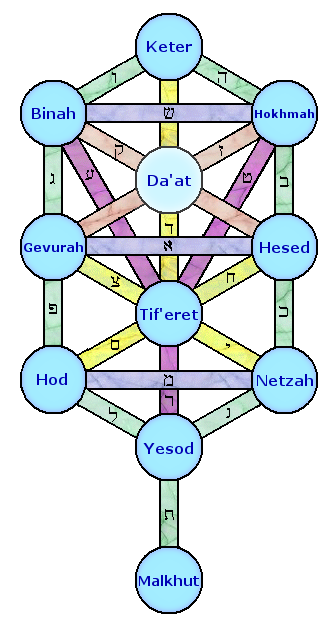
• The explanation of the above passage is that Chesed, Gevurah and Tiferet are nothing other than various phases and levels of G‑d's revealing Himself to man; they are Sefirot, as the introduction to the Zohar states, ‘ You are He who brings forth ten…sefirot. ’[19] In addition to [their] separate and unique identities, they also interact in configurations depicted in Kabbalistic texts; one of which is the partzuf of Zeir Anpin, comprising Chesed, Gevurah, Tiferet, Netzah, Hod and Yesod. Figure 4 depicts all ten sefirot arranged in vertical arrays along three parallel axes,... referred to in kabbalistic literature as a sulam ("ladder") or an eitz ("tree"). The soul can only perceive and ascend [the ladder/ tree] to the higher sefirot through the portal of Malchut, the lowest of the ten sefirot, directly beneath Yesod. This is the gate to G‑d, the righteous shall enter through it" (Psalms 118:20). When this is not done, the result is galut haShechinah.[20] Malchut...is identified as the Shechinah, in this view the Shechinah is understood to be the feminine aspect of God — not an independent mythic being.[21] Unsullied thoughts and pious deeds render one worthy of the Shechinah... sins, on the other hand, cause the Shechinah to depart (Targ. to Isa. lvii. 7; Jer. xxxiii. 5 et passim).[22]
• The waning of the moon was conceived by the kabbalists as a symbol of the exile of the Shechinah ("Divine Presence")[23], while benediction [of] the new moon in its due time [welcomes] the presence of the Shechinah, and may date back to before the Second Temple period.[24] For Moshe Miller, Malchut receives her light from Zeir Anpin, just as the moon receives its light from the sun. But in the future Zeir Anpin will receive from Malchut. This will be achieved by virtue of the [commandments].[25] Gal Einai, a Chassidut website devoted to the teachings of Rabbi Yitzchak Ginsburgh[26], elaborates more on this heavenly relationship: 'The sun represents the male figure (the bestower of light, whereas the moon is the receiver of light), and in particular the sefirah of yesod("foundation"; yesod = 80 = 8 · 10, chet times yud = chai), as personified by Adam.'[27]
Noahite sub-movements within Judaism

• According to the website 13 Petals, which exists ‘ primarily to help non-Jews get closer to G- d[28],… [the] name “Yeshua Sar haPanim” is in the portion [of some Orthodox prayer books] that deal with the order of Shofar blasts, together with Eliyahu the prophet and MemTet Sar haPanim (Prince [Mattat]), which gives us the acronym of Moshe. These three names come as a triad, after the mention of the angel Tartiel… Interesting consideration is that the names share the gematria of 52, which is the gematria of “Messiah” [Mashiakh] in ordinal numbers’… [for Rabbi Nathan Shapira] the role of these three is to testify about the deeds of the souls who ascend to Gan Eden. ’
• ‘ In the Vilna Gaon’s school of thought it is explained that MemTet is the angel that represents Messiah ben Yosef: “The Messiah ben Yosef from above is MemTet Sar haPanim, as it is known that Yosef is [a spark incarnation of] MemTet [cf. Shaar haGilgulim 31:7b]. Both of them are from the light of above and from the Sefirot of Yesod, being active in the war against [the spiritual force in charge of destroying the people of G-d, called] Armilus”… Eliyahu the prophet in the same manner is supposed to come back before Messiah ben David, to “prepare the way”. ’[29]
• 13 Petals concludes ‘ It is important to notice that in the Hasidei Ashkenaz Judaism, G-d is incorporeal, invisible, and beyond eternity. All that exists and all that we know has been emanated from Him. ’[29]
• WikiNoah contributor פטר חמור has also stated that according to his understanding of oral tradition, the heavenly sparks of Messiah ben Yosef, Eliyahu and Messiah ben David are united in the Sefirot of Yesod. When conceptualised individually, the Messiah ben Yosef can represent the Begotten Name or the Tree of Life, Eliyahu corresponds to Yesod or the appearance of אֵל רֳאִי, and the Messiah ben David corresponds to Adam Kadmon / רוח אלהים (Spirit of G-d).
• ‘ The Zohar (parashat Vayetzei) says that the Ladder is [MemTet] (The singular Angel of HaShem), who also is the “House of God”; as it’s written: “My Name is within him” (Ex 23:21), and through him all the angels, prayers and blessing ascend and descend, he is called the Gate through which one passes to come within. “Every petition sent to the King, must be through MemTet. Every message and petition from here below, must first go to MemTet, and from thence to the King. MemTet is the Mediator of all that comes from heaven down to the earth, or from the earth up to heaven”. (Zohar Shemot II:51)... Thus he is called: “the Minister of the Presence”, or “Minister of the Shechinah” and also ‘the Body of the King’s Daughter’ (cf. Zohar Shemot II:94b). This MemTet is not a created being, but an emanation that gets filtered within creation. ’[30]
• ‘ It is suspected, though more research is required, that alongside the ancient identification of MemTet as Adam, Enoch or Moshe, there was another idea that involved the identification of MemTet as Jacob... [Moshe] Idel has added to this discussion that underlying the attribution of the measurements [of the body of the Shechinah] to MemTet in the medieval kabbalist literature is an echo of an older motif concerning the identification of MemTet and Adam, a tradition that may have itself influenced the better known and well-documented tradition regarding the transformation of Enoch into MemTet. ’[31] From the Jewish Virtual Library: ‘ This doctrine developed in the tannaitic period as the most secret part of Merkabah mysticism... Many kabbalists (Jacob b. Jacob ha-Kohen, Isaac b. Samuel of Acre, Judah Ḥayyat) saw it as a description of MemTet, or of the primeval Adam (Adam Kadmon). ’[32]
• ‘ In the ["the Vision of the Merkabah" (Ẓefiyat ha-Merkabah)], [MemTet is the] the central figure and chief actor. Those under this strange hallucination, who imagine themselves entering the Heavenly Chariot and floating through the air, are called "Yorede Merkabah". In this chariot they are supposed to ascend to the heavens, where in the dazzling light surrounding them they behold the innermost secrets of all persons and things, otherwise impenetrable and invisible. Besides the descriptions of the seven heavens with their hosts of angels, and the various storehouses of the world, and of the divine throne above the highest heaven, the most remarkable feature is that the mysteries rest on the belief in the reality of the things seen in an ecstatic state brought about by ablutions, fasts, fervent invocations, incantations, and by other means. ’[33]
Buddhism

![[figure 1]](/en/images/9/9c/SEINE_CUP.jpg)
![[figure 2]](/en/images/2/29/Auxerre_manuscrit.jpg)
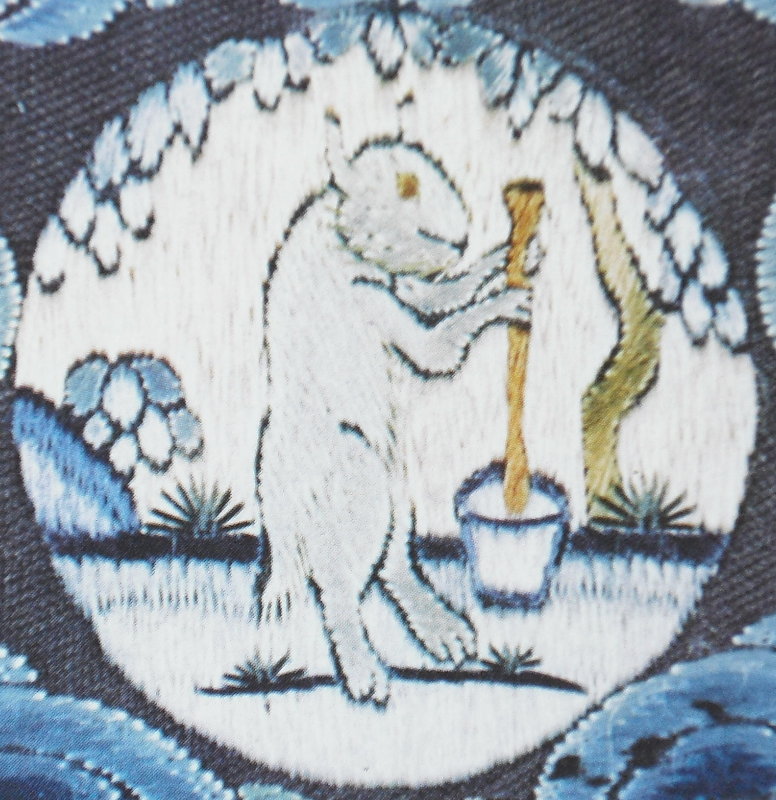
• In the Buddhist Sasa-Jataka text, tale no 316 relates a story given by the Buddha after seven days of feasts, in which a young hare preaches the 'truths' of alms giving, moral law observation and the keeping of holy days to three companions. As a poor brahmin passes by, the three proceed to offer him food, while the hare offers to sacrifice himself. A heap of burning coals then magically appears, into which the hare jumps, however it is miraculously unharmed. The brahmin reveals himself to be the Buddhist deity Sakka, and praises the hare's virtue, proceeding to daub the sign of the hare on the orb of the moon. The four companions then '[dwell] happily and harmoniously together', with the Buddha finally revealing it was he who was the wise hare.[34] A version of this story is found in the Japanese anthology Konjaku monogatari shu[35], while ‘a similar story is also seen in the Chinese anthology Chu Ci where a toad and a hare on the moon pound herbs for the immortals (Figure 5)[36].
• Maitreya, in Buddhist tradition, the future Buddha, [who will] preach anew the dharma (“law”) when the teachings of Gautama Buddha have completely decayed[37], was 'one which evolved from one of the sun gods Mithra’ according to Rui Chuanming.[38] Similar connections are identified by Wiesner[39] and Kohler[40] between the characters of MemTet and Mithra, the Merkabah and chariot of Mithra being one.
• Between India and China there exist ancient places of worship in which the symbol of three (or four) hares is designated or possibly linked to Maitreya. These are the Mogao Caves, in Dunhuang[41]; Basgo Monastery, in Ladakh[42]; and the Three-Storeyed Temple or Sumtsek (གསུམ་བརྩེགས་) in Alchi, Ladakh.[43] Mr. Guan Youhui, retired researcher at the Dunhuang Academy, believes the symbol may have been brought by Sogdians from Zoroastrianism, which would explain the hares wearing scarfs, representing Sassanian divine nature.Cite error: Closing </ref> missing for <ref> tag
- ↑ Cite error: Invalid
<ref>tag; no text was provided for refs namedFN1 - ↑ 2.0 2.1 Terrier, M. (2007) / Chagford - Devon - Angleterre XVe (Archived: 17 April 2012).
- ↑ 3.0 3.1 Meier, A. (2016) The Mystery of the Three Hares Motif. (Archived: 14 December 2022).
- ↑ 4.0 4.1 Greeves, T.; Andrews, S.; Chapman, C. (2016) The Three Hares: A Curiosity Worth Regarding p.64
- ↑ 5.0 5.1 Butterflies, G.; Red Judaism; Eric the Great (18 April 2022) The Great Easter Bunny Hunt!. (Archived: 27 January 2023).
- ↑ 6.0 6.1 Sefaria.org Leviticus.11.6. (Archived: 25 July 2024).
- ↑ 7.0 7.1 Handelman, S. On the Essence of Ritual Impurity. (Archived: 03 March 2024).
- ↑ 8.0 8.1 Yaniv, B. (2012). The Hidden Message of the Hares in the Talons of the Eagle, AJS Review , November 2012, Vol. 36, No. 2 (November 2012), Published by: Cambridge University Press on behalf of the Association for Jewish Studies, p.294
- ↑ 9.0 9.1 Horowitz, E. (2004). Odd Couples: The Eagle and the Hare, the Lion and the Unicorn, Jewish Studies Quarterly , 2004, Vol. 11, No. 3, Icon, Image, and Text in Modern Jewish Culture, Published by: Mohr Siebeck GmbH & Co. KG, p.256
- ↑ 10.0 10.1 Khaimovich, B. (2011): On the semantics of the motif “three hares chasing each other in a circle” on Jewish monuments in Eastern Europe, East European Jewish Affairs, 41:3, p.169
- ↑ 11.0 11.1 11.2 Author Unknown (2016) The “Three Hares” motif — a worldwide (including Jewish) curiosity. (Archived: 24 August 2022).
- ↑ 12.0 12.1 Bukovec, P. (2012) Ashkenazi Jews in Early Modern Europe. (Archived: 25 October 2021).
- ↑ 13.0 13.1 Khaimovich, B. (2011): On the semantics of the motif “three hares chasing each other in a circle” on Jewish monuments in Eastern Europe, East European Jewish Affairs, 41:3, p.157, p.170
- ↑ 14.0 14.1 Khaimovich, B. (2011): On the semantics of the motif “three hares chasing each other in a circle” on Jewish monuments in Eastern Europe, East European Jewish Affairs, 41:3, p.164
- ↑ 15.0 15.1 Witschnitzer, R. (1935) Symbole und Gestalten und Symbole der jüdischen Kunst. Berlin-Schöneberg: S. Scholem (in German) (Forms and Symbols of Jewish Art), p.135
- ↑ 16.0 16.1 Sefaria.org Likutei Moharan 16:1. (Archived: 26 March 2023).
- ↑ 17.0 17.1 Khaimovich, B. (2011): On the semantics of the motif “three hares chasing each other in a circle” on Jewish monuments in Eastern Europe, East European Jewish Affairs, 41:3, p.166
- ↑ 18.0 18.1 Zohar, Vayera 1:98b. (Archived: 27 September 2022).
- ↑ 19.0 19.1 Miller, M. Worlds and Emanations. (Archived: 26 October 2022).
- ↑ 20.0 20.1 Miller, M. Emanations Interact. (Archived: 07 March 2023).
- ↑ 21.0 21.1 Schwartz, H. Shekhinah, God's Bride. (Archived: 30 June 2024).
- ↑ 22.0 22.1 Kaufmann, K., Blau, L. SHEKINAH (; lit. "the dwelling"). (Archived: 22 May 2024).
- ↑ 23.0 23.1 Jewishvirtuallibrary.org Yom Kippur Katan. (Archived: 08 April 2024).
- ↑ 24.0 24.1 Jewishvirtuallibrary.org Moon, Blessing of the. (Archived: 08 April 2024).
- ↑ 25.0 25.1 Miller, M. Stanza 8. (Archived: 11 August 2022).
- ↑ 26.0 26.1 Inner.org/rav/ About Rabbi Ginsburgh. (Archived: 28 November 2023).
- ↑ 27.0 27.1 GalEinai, I. (2014) The Hebrew Letters: Kuf - Omnipresence – Redemption of Fallen Sparks. (Archived: 23 December 2023).
- ↑ 28.0 28.1 Casal, X. About 13 Petals. (Archived: 01 December 2022).
- ↑ 29.0 29.1 29.2 Casal, X. (2015) Sar haPanim in the Machzor for Yom Kippur. (Archived: 19 March 2023).
- ↑ 30.0 30.1 Casal, X. (2015) Parashat Vayetzei – Yakov’s Ladder and Messiah. (Archived: 30 November 2022).
- ↑ 31.0 31.1 Wolfson, E.Metatron and Shi' ur Qomah in the Writings of Haside Ashkenaz, in Mysticism, Magic and Kabbalah in Ashkenazi Judaism, 60-92. Edited by K. Grözinger and J. Dan. Tübingen: J. C. B. Mohr, 1995.
- ↑ 32.0 32.1 Jewishvirtuallibrary.org Shi’ur Komah. (Archived: 11 April 2024).
- ↑ 33.0 33.1 Kohler, K. Merkabah (lit. "chariot"), ©2002-2021, JewishEncyclopedia.com. All rights reserved. (Archived: 07 March 2023).
- ↑ 34.0 34.1 Francis, H.T.; Neil, R.A. (1897) No. 316. SASA-JĀTAKA., The Jataka, Vol. III, sacred-texts.com. (Archived: 30 October 2023).
- ↑ 35.0 35.1 Ury, M. (1993) Tales of Times Now Past: Sixty-Two Stories from a Medieval Japanese Collection, University of Michigan Center for Japanese Studies, CC BY-NC-ND 4.0 DEED, pp. 56-58.
- ↑ 36.0 36.1 Storymuseum.org.uk The Hare in the Moon. (Archived: 01 December 2023).
- ↑ 37.0 37.1 Britannica.com Maitreya-Buddhism. (Archived: 20 February 2023).
- ↑ 38.0 38.1 Chuanming, R. A Study on the Relations between Maitreyan Faith and Manichaeism, p.372. (Archived: 29 September 2022).
- ↑ 39.0 39.1 Weisner, Ben Chananja (1862), p.384; (1866), pp. 600-625.
- ↑ 40.0 40.1 Kohler, K. Jewish Theology, ed. New York (1918), p.185.
- ↑ 41.0 41.1 Greeves, T.; Andrews, S.; Chapman, C. (2016) The Three Hares: A Curiosity Worth Regarding p.209
- ↑ 42.0 42.1 Greeves, T.; Andrews, S.; Chapman, C. (2016) The Three Hares: A Curiosity Worth Regarding p.228
- ↑ 43.0 43.1 Luczanits, C. Three-Storeyed Temple. (Archived 16 Aug 2022).
- ↑ Greeves, T.; Andrews, S.; Chapman, C. (2016) The Three Hares: A Curiosity Worth Regarding pp.207,214
- ↑ Chinesepuzzles.org Three rabbits with one ear. (Archived 24 March 2024).
- ↑ Oxfordreference.com Sakinah. (Archived 22 September 2024).
- ↑ Greeves, T.; Andrews, S.; Chapman, C. (2016) The Three Hares: A Curiosity Worth Regarding p.211, p.209
- ↑ Britannica.com Sukhavati - Buddhist belief. (Archived 22 Sep 2022).
- ↑ Greeves, T.; Andrews, S.; Chapman, C. (2016) The Three Hares: A Curiosity Worth Regarding p.204, p.208
- ↑ Greeves, T.; Andrews, S.; Chapman, C. (2016) The Three Hares: A Curiosity Worth Regarding p.208, p.220
- ↑ Metmuseum.org Jūichimen Kannon, the Bodhisattva of Compassion with Eleven Heads (Avalokiteshvara). (Archived: 23 January 2022).
- ↑ Terrier, M. (2007) Auxerre Manuscript (Archived: 7 April 2023).
- ↑ Khaimovich, B. (2011): On the semantics of the motif “three hares chasing each other in a circle” on Jewish monuments in Eastern Europe, East European Jewish Affairs, 41:3, pp.158,159
- ↑ Metmuseum.org The Five Pillars of Islam. (Archived: 28 June 2023).
- ↑ Greeves, T.; Andrews, S.; Chapman, C. (2016) The Three Hares: A Curiosity Worth Regarding p.241
- ↑ Corpus.quran.com Verse (4:171) - Word by Word (Archived: 07 December 2022).
- ↑ Gallop, Annabel Teh. (2019) Three fish with one head: (1) Sufi sources from Southeast Asia, blogs.bl.uk (Archived: 20 March 2023).
- ↑ Sunnah.com Jami` at-Tirmidhi 3723, 49 Chapters on Virtues (Archived: 09 April 2023).
- ↑ Mahajjah.com 8. The Nusayri “Trinity: Ali, Muhammad and Salman al-Farisi (Archived: 01 April 2023).
- ↑ Procházka-Eisl, G. (2016) The Alevis, Oxford Research Encyclopedia of Religion, oxfordre.com.
- ↑ Yaman, A.; Erdemir A. (2006) Alevism-Bektashism A Brief Introduction p.67
- ↑ Britannica.com 5 Things People See in the Moon. (Archived 21 March 2022).
- ↑ Nurmuhammad.com (2020) Reality of Hijrah – Two Faces of the Moon – Abu Bakr (as) and Ali (as). (Archived 10 June 2023).
- ↑ Foster, N. (2023) What is the Three Hares Motif?, wise-geek.com (Archived: 07 January 2024).
- ↑ Meier, A. (2016) The Mystery of the Three Hares Motif, hyperallergic.com (Archived: 17 March 2023).
- ↑ Terrier, M. (2007) trois-lievres.skyrock.com (Archived: 05 August 2023).
- ↑ Metmuseum.org The Holy Family with Three Hares (Archived: 30 July 2024).
- ↑ cpat.org.uk Clwyd Powys Archaeological Trust Historic Settlement Survey - Montgomeryshire, Pennant Melangell, p.1. (Archived: 20 June 2022).
- ↑ Bartrum, P.C. A Welsh Classical Dictionary, M-N, p.532. (Archived: 11 October 2023).
- ↑ Biblehub.com John 1:29; 1:35 (Archived: 07 June 2023).
- ↑ ccel.org JESUS CHRIST, THREEFOLD OFFICE OF, The New Schaff-Herzog Encyclopedia of Religious Knowledge, Vol. VI: Innocents - Liudger. (Archived: 10 January 2024).
- ↑ catholiccrossreference.online 7) Fathers of the Second Century, THEOPHILUS, Theophilus to Autolycus Book II Chapter XXII.—Why God is Said to Have Walked, courtesy of the Church Fathers Scripture Search Engine. (Archived: 16 July 2024).
- ↑ earlychristianwritings.com Peel, Malcolm L. and Zandee, Jan. The Teachings of Silvanus. Early Christian Writings. 2022. 12. (Archived: 12 July 2022).
- ↑ Biblehub.com John 2:21 (Archived: 19 May 2024).
- ↑ Biblehub.com John 1:14 (Archived: 16 June 2024).
- ↑ Biblehub.com John 14:6 (Archived: 24 March 2024).
- ↑ Biblehub.com Mark 9:2-4 (Archived: 28 February 2024).
- ↑ Bucur, Bogdan G. (2015). The Early Christian Reception of Genesis 18: From Theophany to Trinitarian Symbolism, Journal of Early Christian Studies 23:2, © 2015 Johns Hopkins University Press, p.255
- ↑ Bucur, Bogdan G. (2015). The Early Christian Reception of Genesis 18: From Theophany to Trinitarian Symbolism, Journal of Early Christian Studies 23:2, © 2015 Johns Hopkins University Press, p.272, p.254
- ↑ Wolfson, Elliot R. (2001). Messianism in the Christian Kabbalah of Johann Kemper, in Millenarianism and Messianism in the Early Modern European Culture: Jewish Messianism in the Early Modern World, edited by Matthew D. Goldish and Richard H. Popkin (The Netherlands: Kluwer Academic Publishers), p.16
- ↑ allnations.adventistchurch.org.uk What is the Shekinah glory?. (Archived: 29 July 2024).
- ↑ Pettazzoni, R. (1946) The Pagan Origins of the Three-Headed Representation of the Christian Trinity, Journal of the Warburg and Courtauld Institutes , 1946, Vol. 9, p.151
- ↑ Pettazzoni, R. (1946) The Pagan Origins of the Three-Headed Representation of the Christian Trinity, Journal of the Warburg and Courtauld Institutes , 1946, Vol. 9, p.146
- ↑ Hofstadter, D. (1981) Gödel, Escher, Bach: An Eternal Golden Braid, Penguin Books Ltd, London, 1st Edition, p.578
- ↑ Merkelbach, R. (2024) Mithraism - Persian religion, Britannica.com. (Archived 04 August 2024).
- ↑ Pettazzoni, R. (1946) The Pagan Origins of the Three-Headed Representation of the Christian Trinity, Journal of the Warburg and Courtauld Institutes , 1946, Vol. 9, pp.146,147,149
- ↑ Britannica.com Rashnu, Zoroastrian deity. (Archived 24 April 2024).
- ↑ Britannica.com Sraosha, Zoroastrianism. (Archived 03 June 2023).
- ↑ Iranicaonline.org Cautes and Cautopates. (Archived: 05 October 2023).
- ↑ Hindupedia.com Theology. (Archived: 06 July 2024).
- ↑ Hindupedia.com Trimurti. (Archived: 06 June 2023).
- ↑ Hindupedia.com Brahmā. (Archived: 29 April 2024).
- ↑ encyclopedia.com Oṃ. (Archived: 20 September 2023).
- ↑ Iranicaonline.org Manicheism i. General Survey. (Archived: 04 April 2023).
- ↑ Chuanming, R. A Study on the Relations between Maitreyan Faith and Manichaeism, pp.365,366. (Archived: 29 September 2022).
- ↑ Iranicaonline.org Manicheism iv. Buddhist Elements in. (Archived: 05 February 2023).
- ↑ Arendzen, J.P. (1913) Manichaeism ii. System of Doctrine and Discipline. (Archived: 30 November 2022).
- ↑ Boyce, M. (Copyright © 1998~ CAIS (The Circle of Ancient Iranian Studies)) An Introduction to Manichaeism, Extracted & Edited from: "A reader in Manichaean Middle Persian and Parthian". (Accessed: 31 May 2023 from "CAIS-SOAS").
- ↑ Iranicaonline.org Manicheism ii. The Manichaen Pantheon. (Archived: 05 February 2023).
- ↑ Chuanming, R. A Study on the Relations between Maitreyan Faith and Manichaeism, pp.380,381,384. (Archived: 29 September 2022).
- ↑ Franzmann, M. (2003). Jesus in the Manichaean Writings pp.7,8
- ↑ Bateson, G. (1972) Steps to an Ecology of Mind: Collected Essays in Anthropology, Psychiatry, Evolution, and Epistemology, Copyright ® 1972, 1987 by Jason Aronson Inc., Northvale, New Jersey, London. Originally published by Chandler Pub. Co., San Franciso, 1972, p.501
- ↑ Bateson, G. (1972) Steps to an Ecology of Mind: Collected Essays in Anthropology, Psychiatry, Evolution, and Epistemology, Copyright ® 1972, 1987 by Jason Aronson Inc., Northvale, New Jersey, London. Originally published by Chandler Pub. Co., San Franciso, 1972, p.155
- ↑ Bateson, G. (1972) Steps to an Ecology of Mind: Collected Essays in Anthropology, Psychiatry, Evolution, and Epistemology, Copyright ® 1972, 1987 by Jason Aronson Inc., Northvale, New Jersey, London. Originally published by Chandler Pub. Co., San Franciso, 1972, p.238
- ↑ Rittel, H.; Webber, M. (1973) Dilemmas in a General Theory of Planning, Policy Sciences volume 4, issue 2 (1973), Copyright 1973, Elsevier Scientific Publishing Company, p.166.
- ↑ Sweeting, B. (2018) Wicked problems in design and ethics. In P. H. Jones & K.Kijima (Eds.), Systemic design: Theory, methods, and practice (pp. 119-143). Tokyo: Springer Japan. DOI: 10.1007/978-4-431-55639-8, p.6
- ↑ Hofstadter, D. (1981) Gödel, Escher, Bach: An Eternal Golden Braid, Penguin Books Ltd, London, 1st Edition, p.137
- ↑ Hofstadter, D. (1981) Gödel, Escher, Bach: An Eternal Golden Braid, Penguin Books Ltd, London, 1st Edition, pp.473,474