
The Three Hares

The Three Hares is an enigmatic and ancient symbol, which according to leading expert Dr Tom Greeves 'in so many places was given overtly special status or sacred status, as the centrepiece of Buddhist caves in Dunhuang, or on an Islamic coin, or cast into one of the finest bells in Christian Europe, … [and] almost certainly used on different levels and meanings… Today we are free to interpret [its meaning]'. The symbol features three hares running or crouching in a Strange Loop, with the ears of each hare shared by another. Potentially its earliest depiction (dated 1CE/BCE or alternatively a Volder or neoclassical replica) has one hare running and the others crouching, as depicted on the bottom of the Seine Cup [figure 1].[1]
According to Three Hares expert Michel Terrier, 81.3% of Hares in England are turning counter clockwise [while] 80% of Chinese hares turn clockwise.[2] While some believe the rabbits symbolize eternity… [or] fertility, others consider them a representation of the connection between the heavens and the earth.[3] For for William Wotton and Browne Willis in 1716, the meaning of the three hares by then was lost.[4]
Contents
A Noahite interpretation (2022) of the symbol

Inspired by a Judaic outer message presented by פטר חמור and subsequent framework identifications, on 18 April 2022 WikiNoah contributor המשיח הוא יהדות presented a Noahite interpretation of the Three Hares symbol on the Red Judaism (now Bei Abidan) YouTube channel, alongside פטר חמור and Eric the Great.[5] The interpretation is labelled such given it works from a Judaic reference point and extrapolates relevant meaning via a combination of consistent markers and theological (self-)references into academic scholarship. In addition, symbological references related to the Auxerre Manuscript [figure 2]; first published in the 13th Century and brought to public attention by Michel Terrier, are highlighted green. Using this interpretation, a higher-level correspondence is identified, lending credence to Wotton and Willis’ claim of a potential root meaning.
Judaism
• Related instances of the three hares are found in Ukraine and particularly Podolia[6], which acted as a cultural bridgehead via which the Messianic tension of the Sephardic Jews in the Ottoman Empire was transferred to Eastern Europe.[7]
• According to Dr Boris Khaimovich, who is described as one of the most important and insightful researchers into Jewish gravestone epitaphs and iconography[6], on some monuments the motif of the “three hares” paradoxically replaces the “three overlapping fish”. Such a representation would seem to be possible only if they are identical semantically and contextually. The image of “three fish” on an eagle’s breast… can be interpreted as a metaphor for Shekhinah which rests on righteous men.[8]
• Dr Khaimovich references Jewish art historian Rahel Wischnitzer in stating ‘Apparently, these or similar texts once gave [her] reason to believe that the three [overlapping] fish pictured on a platter for Purim, from Bamberg, symbolise the two Messiahs and the prophet Elijah.’[9]
• According to Wischnitzer herself, they refer more specifically to ‘Elijah - the proclamatory of the Messiah, the Messiah ben Yosef - also proclamatory of the Messiah, and the Messiah ben David’.[10]
• A similar allegorical meaning can be drawn from Likutei Moharan 16:1, which describes a fish encountered by Rav Yochanan as having 'naFiTZ (spouted out) water from his two nostrils — This alludes to the two Messiahs' [11] (credit to פטר חמור).
• Dr Khaimovich’s interpretation of the image of the three hares on gravestones is that they are associated with ‘the names of the righteous (the forefathers and foremothers) and the name Moshe.’[12]
• A connection to Dr Khaimovich’s interpretation can be identified in the Zohar, an esoteric book within the folds of Judaism, which describes the account of Abraham’s visitation by lower elements of G-d’s divinity in Genesis 18:2 – ‘ "And the Shechinah rested upon [Abraham] in full perfection, as should properly be… he lifted up his eyes and looked, and lo, three men stood by him..." (Gen. 18: 2) Who are these three men? They are Abraham, Isaac, and Jacob [the forefathers] (i.e., Chesed, Gevurah and Tiferet of Zeir Anpin).’[13]
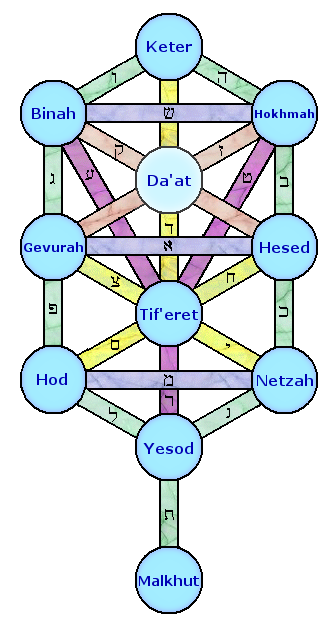
• The explanation of the above passage is that Chesed, Gevurah and Tiferet are nothing other than various phases and levels of G‑d's revealing Himself to man; they are Sefirot, as the introduction to the Zohar states, "You are He who brings forth ten…sefirot."[14] In addition to [their] separate and unique identities, they also interact in configurations depicted in Kabbalistic texts; one of which is the partzuf of Zeir Anpin, comprising Chesed, Gevurah, Tiferet, Netzah, Hod and Yesod. Figure 3 depicts all ten sefirot arranged in vertical arrays along three parallel axes,... referred to in kabbalistic literature as a sulam ("ladder") or an eitz ("tree"). The soul can only perceive and ascend [the ladder/ tree] to the higher sefirot through the portal of Malchut, the lowest of the ten sefirot, directly beneath Yesod. This is the gate to G‑d, the righteous shall enter through it" (Psalms 118:20). When this is not done, the result is galut haShechinah — the exile of the Divine Presence.[15]
• The relationship of Zeir Anpin to Shechinah (associated with Malchut)[16] is likened to that of the Sun and the Moon; ‘Rabbi Yitzchak [disagreed and] said: supernal light [Zeir Anpin, the Giving force of tiferet] and lower light [malchut, the lowest of the ten sefirot included together are called "V'ata" [the vav represents tiferet and "ata" – you, represents the Shechinah], as it says: "and You give life to them all" (Nehemiah 9:6) and therefore it doesn't say: "and bring near to yourself Aaron your brother " [without the explicit "you" – Ed.], "And command the children of Israel", "And speak to all that are wise hearted", because at that time [of erecting the Tabernacle], the sun [tiferet] rested with the moon [malchut] and all [sefirot] participated together to rest on their workmanship [of the Mishkan] that they had made.’[17]
Noahite sub-movements within Judaism

• According to the website 13 Petals, which exists ‘primarily to help non-Jews get closer to G- d[18],… [the] name “Yeshua Sar haPanim” is in the portion [of some Orthodox prayer books] that deal with the order of Shofar blasts, together with Eliyahu the prophet and MemTet Sar haPanim (Prince [Mattat]), which gives us the acronym of Moshe. These three names come as a triad, after the mention of the angel Tartiel… Interesting consideration is that the names share the gematria of 52, which is the gematria of “Messiah” [Mashiakh] in ordinal numbers’… [for Rabbi Nathan Shapira] the role of these three is to testify about the deeds of the souls who ascend to Gan Eden.’
• In the Vilna Gaon’s school of thought it is explained that MemTet is the angel that represents Messiah ben Yosef: “The Messiah ben Yosef from above is MemTet Sar haPanim, as it is known that Yosef is [a spark incarnation of] MemTet [cf. Shaar haGilgulim 31:7b]. Both of them are from the light of above and from the Sefirot of Yesod, being active in the war against [the spiritual force in charge of destroying the people of G-d, called] Armilus”… Eliyahu the prophet in the same manner is supposed to come back before Messiah ben David, to “prepare the way”.[19]
• 13 Petals concludes ‘It is important to notice that in the Hasidei Ashkenaz Judaism, G-d is incorporeal, invisible, and beyond eternity. All that exists and all that we know has been emanated from Him’.[19]
• WikiNoah contributor פטר חמור has also stated that according to his understanding of oral tradition, the heavenly sparks of Messiah ben Yosef, Eliyahu and Messiah ben David are united in the Sefirot of Yesod. When conceptualised individually, the Messiah ben Yosef can represent the Begotten Name or the Tree of Life, Eliyahu corresponds to Yesod or the appearance of אֵל רֳאִי, and the Messiah ben David corresponds to Adam Kadmon / רוח אלהים (Spirit of G-d).
• The Zohar (parashat Vayetzei) says that the ladder is [MemTet] (The singular Angel of HaShem), who also is the “House of God”; as it’s written: “My Name is within him” (Ex 23:21), and through him all the angels, prayers and blessing ascend and descend, he is called the Gate through which one passes to come within. “Every petition sent to the King, must be through MemTet. Every message and petition from here below, must first go to MemTet, and from thence to the King. MemTet is the Mediator of all that comes from heaven down to the earth, or from the earth up to heaven”. (Zohar Shemot II:51). This MemTet is not a created being, but an emanation that gets filtered within creation.[20]
• In the ["the Vision of the Merkabah" (Ẓefiyat ha-Merkabah)], [MemTet is the] the central figure and chief actor. Those under this strange hallucination, who imagine themselves entering the Heavenly Chariot and floating through the air, are called "Yorede Merkabah". In this chariot they are supposed to ascend to the heavens, where in the dazzling light surrounding them they behold the innermost secrets of all persons and things, otherwise impenetrable and invisible. Besides the descriptions of the seven heavens with their hosts of angels, and the various storehouses of the world, and of the divine throne above the highest heaven, the most remarkable feature is that the mysteries rest on the belief in the reality of the things seen in an ecstatic state brought about by ablutions, fasts, fervent invocations, incantations, and by other means.[21]
Buddhism

• Maitreya, in Buddhist tradition, the future Buddha, [who will] preach anew the dharma (“law”) when the teachings of Gautama Buddha have completely decayed[22], was 'one which evolved from one of the sun gods Mithra’ according to Rui Chuanming.[23] Similar connections are identified by Wiesner[24] and Kohler[25] between the characters of MemTet and Mithra, the Merkabah and chariot of Mithra being one.
• Between India and China there exist ancient places of worship in which the symbol of three (or four) hares is designated or possibly linked to Maitreya. These are the Mogao Caves, in Dunhuang[26]; Basgo Monastery, in Ladakh[27]; and the Three-Storeyed Temple or Sumtsek in Alchi, Ladakh.[28]
• Within the Mogao Caves, several depictions of the three hares within lotus buds are found; Cave 139 hosts the Boddhisatva Avalokiteśvara above its entrance with an eight-petal lotus containing three hares, and Cave 205 depicts three hares in what is presumed to be a lotus together with wall paintings of the paradise of Maitreya.[29] In Buddhist theology, the newly dead enter into lotus buds, which unfold when the occupants have become entirely purified and have attained enlightenment.[30] Depictions of the three hares surrounded by blossoming lotuses bright and luminious as moonlight (Cave 407), or Avalokiteśvara together with the sun and the moon (Cave 99) also imply connections with these astral bodies; especially the moon, according to The Three Hares: A Curiosity Worth Regarding.[31]
• Turning to Sumtsek one finds three deers, three bulls, three rabbits and three hares on the dhoti of Maitreya, in red circular medallions on blue ground. The Temple is dedicated to Maitreya as one of three bodhisattvas who defer enlightenment to help others; including Avalokiteśvara who is understood to represent Compassion and the Word, and Mañjuśrī who is understood to represent Wisdom.[32]
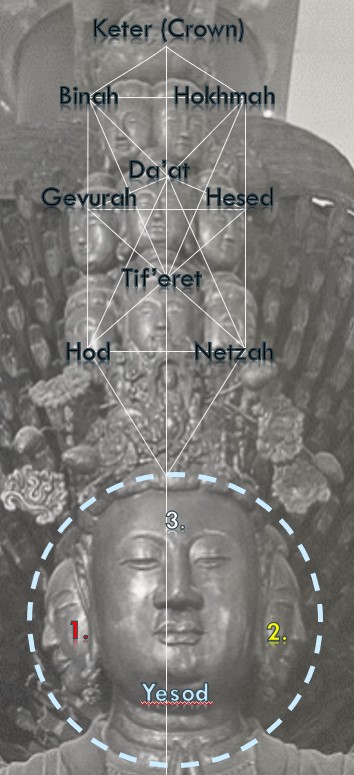
• Avalokiteśvara, also known as Jūichimen Kannon ("Eleven-headed Kannon"), has Eleven Heads atop its own head as its name implies, ten of [which] take the form of bodhisattvas and represent the ten stages toward enlightenment.[33] Remarkably, Figure 4 demonstrates how the location of each head corresponds directly to a sefirot in the Tree of Life, with the bottom and most prominent three-faced head or trifron forming a unity in the Sefirot of Yesod. In identifying the isomorphism between the ten stages [of enlightenment] and ten sefirot, the lotus leaf finds its natural counterpart in the Merkabah of MemTet; the vehicle in which the soul ascends through the portal of Malchut ('the moon') into Zeir Anpin ('the sun'). The visual emphasis placed on the trifron (Yesod) may signify the location and role of Avalokitshevara in its closeness to the newly dead (credit: המשיח הוא יהדות).
• The symbol of the trifron also appears in the Auxerre Manuscript alongside (from right to left); three hares, four hares and three overlapping fish - all but one are found in the Mogao Caves alongside icons of Maitreya and Avalokiteśvara, providing a further self-referential twist. המשיח הוא יהדות concludes that a higher-level correspondence between the symbols in the Auxerre Manuscript can be identified once a Judaic standpoint is taken with regards to occurrences of the three hares in Buddhist iconography. Furthermore it is likely the manuscript author understood these to be cognate symbols; though on which level and from which standpoint is unclear. As Michel Terrier states, "Few texts usually accompany the three hares, it is important now to translate the texts in red that surround these patterns".[34]
Manichaean Gnosticism
• Manichaeism is the only world religion that has become completely extinct - much of what was previously known was through anti-Manichaen polemics, however in the 20th century genuine Manichaen texts and documents came to light. Research suggests that between Manichaeism, Judaism and Buddhism the figure of Maitreya-MemTet is a consistent marker, though use of the Three Hares or related symbols has not been identified with the former. The founder of Manichaeism, Mani, lived in the 3rd century and in texts concerning his travels to India (240-242 CE), Mani is described as a Buddha (Maitreya).[35] A short Bema hymn of Manichaeism written in both Middle Persian and Parthian further reveals a close [perceived] relationship to Maitreya, labelling him Master Maitreya, Maitragar Maitr Čaitr, Lord Maitreya, Buddha Maitreya and Maitreya.[36] According to Iranicaonline.org this identification cannot be explained as due to later Buddhist influence.[37]
• The significant difference between Manichaeism and the Abrahamic faiths lays in the identification of [Ha-Adam] and [Ha-Ishah's] fashioner; for the former it is 'Naimrael and Ashaklun' of the 'Powers of Evil', who imprison a vast number of 'germs of light' within them. The 'Powers of Light' in return are said to send a saviour, the 'luminous Jesus', who shows [Ha-Adam] the 'Father of Greatness's' dwelling above and reveals his own personality, mixed with and imprisoned in all that exists. This captive 'Cosmic Light' is 'Jesus Patibilis', the "suffering saviour", who makes [Ha-Adam] stand up and taste the forbidden fruit thereby receiving the divine truth or Gnosis. This is to be contrasted with the Genesis 3:1-5 account of the Snake tempting Ha-Adam from the 'Tree of Knowledge of Good and Evil' into sin.[38][35]
• The 'Father of Greatness' subsequently evokes by word several other emanations or 'gods' to do battle with the 'Powers of Evil', one of which is the 'Column of Glory', the path by which the 'Cosmic Light' once redeemed can ascend to the sky. According to "CAIS-SOAS"; by this path the souls pass to the moon at its time of waxing, and thence to the sun, from which they go to the 'New Paradise'. The sun and the moon are variously described as "ships" and "chariots"[39]; a similar description can be seen in Judaic theology. Of the chief emanations from the 'Third Creation', the thrones of 'Jesus the Splendour', the 'Virgin of Light' and the 'Light Nous' are said to reside in the moon, while the 'Third Messenger', 'The Twelve Virgins' and the 'Column of Glory' are said to reside in the sun.[40]
• According to Rui Chuanming, the role of Maitreya, the future Saviour Messiah, is not played exclusively by Mani; on many occasions [in Manichaeism] Maitreya is designated as Jesus.[41] Mani appears to have recognised three entities under the name of Jesus: 1) 'Jesus the Splendour, the redeeming god'; 2) the 'Suffering Jesus', the name given in western Manichaeism to the 'Living Self', i.e. to the sum of the Light suffering in Matter, "crucified" as Jesus was crucified on the cross; 3) 'Jesus the Messiah', prophet and "Son of God", who had taken on the appearance of man, and had seemed to suffer death on the cross... The three conceptions of Jesus are not always kept wholly distinct.[39][42]
Islam

• Under the rule of Mongol rulers Khublai and Abaqa, a coin was minted with three hares (1281-1282) and the shahada, the Islamic statement of faith: There is no god but God, and Muhammad is the Messenger of God.[43] Other coins of [theirs] bear a cross and Christian inscriptions.[44]
• A similar congruence can be seen in Surah 4:171 of The Qu'ran, which decribes three attributes of the character of Isa ibn Maryam [Jesus] Al-Masih, followed by the caveat that 'only Allah is G-d One':
‘Only the Messiah (‘Masīḥu’), Isa, son (of) Maryam, (was) a Messenger (‘Rasūlu’) (of) Allah and His word (‘Kalimatuhu’) which He conveyed to Maryam and a spirit from Him (‘Rūḥun min'hu’). And (do) not say, "Three;" desist (it is) better for you. Only Allah (is) God One. Glory be to Him. That He (should) have for Him a son. To Him (belongs) whatever (is) in the heavens and whatever (is) in the earth. ’ Corpus.quran.com, Sura 4:157[45]
• We also find the three overlapping fish symbol in Islamic texts relating to the Shaṭṭārīyah brotherhood; a Sufi order which spread to Southeast Asia. In two manuscripts, one of which is dated 1790, the symbol is used to illustrate the Oneness (tawhid) of God, by visualising graphically the unity of the first three stages of the ‘seven grades of being’ and making this reference explicit through accompanying captions: aḥadīyah - Allāh / waḥdah - Muḥammad / wāḥidīyah – Adam.
• In one Shaṭṭārīyah manuscript, the fish labelled Allah is left plain and unadorned, most likely to reflect the 'emptiness' associated with the first of the 'seven grades of being' [figure 5]. Other late-19th century manuscripts have each fish labelled with a different descriptor of the stage represented: zat ‘ibarat Allāh - ṣifat ‘ibarat rūḥ/Muḥammad - af‘āl ‘ibarat jasad/Adam (Essence symbolising God / attributes symbolising the soul/Muḥammad / Deeds symbolising the body/Adam).[46]
• The name ‘Muhammad’ is also invoked as part of a triad in sayings (‘hadith’) belonging to other Islamic faith traditions, which are not exhausted below:
‘Narrated 'Ali: that the Messenger of Allah [Muhammad] PBUH said: "I am the house of wisdom, and ‘Ali is its door.“ ’ Jami` at-Tirmidhi 3723[47]
‘I testify that there is no God but Ali… and no hijab (veil) but Lord Muhammad… and no Bab (Gate) but Lord Salman al Farisi. ’ Mahajjah.com, The Nusayri “Trinity[48]
Christianity

![[figure 1]](/en/images/9/9c/SEINE_CUP.jpg)
![[figure 2]](/en/images/2/29/Auxerre_manuscrit.jpg)
![[figure 5]](/en/images/f/fc/Three_fish_one_head.jpg)
Mithraism
Paganism
Hinduism
Ancient Egyptian Pantheon
Evidence summary
With the obvious difficulties of establishing conscious translation of meaning amongst occurrences of the Three Hares and related symbols, it is rather curious to note that the relative success of a Noahite interpretation can otherwise be attributed to a Strange Loop unconscious translation, mirroring the symbolic depiction.
Epistemological implications
According to Dr Sue Andrew, an expert on the Hares, if “we seek a precise meaning for the Three Hares, at the expense of understanding what they do, we might just miss their real significance, for running in their never-ending circle they may have stirred memories and powered prayer in ways we are only just beginning to understand.”[1]
The imposition of plain meaning can therefore serve to obscure what could be described at one level as the depiction of "a feedback loop" which also functions as a feedback loop, in its accumulation of both implicit and explicit meaning. That the context of the appearances of the Three Hares may plainly defy reductionism yet simultaneously hold hidden depths of consistent meaning amongst layers of accumulated meaning, should not be a surprise nor a contradiction of two mutually exclusive states, rather a symbolic affirmation of the diversity of shared meaning that we ourselves are testament to. An inconceivable appreciation of the symbol as both a mediator of stability in meaning and a powerful connector to new levels of meaning may now be identified.
Under the section "Modern uses of the symbol" examples are provided where the symbol has inspired or been used in inspiring people to identify and generate new levels of connection.
Potential further connections
Yoruba Pantheon
Potential theological interpretations
Micah 4:5 וְיָֽשְׁב֗וּ אִ֣ישׁ תַּ֧חַת גַּפְנ֛וֹ וְתַ֥חַת תְּאֵֽנָת֖וֹ וְאֵ֣ין מַֽחֲרִ֑יד כִּי־פִ֛י יְהֹוָ֥ה צְבָא֖וֹת דִּבֵּֽר:
Modern uses of the symbol
Credit
Original research and article by WikiNoah contributor המשיח הוא יהדות, key contributions from WikiNoah contributor פטר חמור, contributions from Eric the Great, and special thanks to the author/s of The Three Hares: A Curiosity Worth Regarding notwithstanding.
References
Footnotes
- ↑ Greeves, T.; Andrews, S.; Chapman, C. (2016) The Three Hares: A Curiosity Worth Regarding p.320, p.67
- ↑ Terrier, M. (2007) / Chagford - Devon - Angleterre XVe (Archived: 17 April 2012).
- ↑ Meier, A. (2016) The Mystery of the Three Hares Motif. (Archived: 14 December 2022).
- ↑ Greeves, T.; Andrews, S.; Chapman, C. (2016) The Three Hares: A Curiosity Worth Regarding p.64
- ↑ Butterflies, G.; Red Judaism; Eric the Great (18 April 2022) The Great Easter Bunny Hunt!. (Archived: 27 January 2023).
- ↑ 6.0 6.1 Author Unknown (2016) The “Three Hares” motif — a worldwide (including Jewish) curiosity. (Archived: 24 August 2022).
- ↑ Bukovec, P. (2012) Ashkenazi Jews in Early Modern Europe. (Archived: 25 October 2021).
- ↑ Khaimovich, B. (2011): On the semantics of the motif “three hares chasing each other in a circle” on Jewish monuments in Eastern Europe, East European Jewish Affairs, 41:3, p.157, p.170
- ↑ Khaimovich, B. (2011): On the semantics of the motif “three hares chasing each other in a circle” on Jewish monuments in Eastern Europe, East European Jewish Affairs, 41:3, p.164
- ↑ Witschnitzer, R. (1935) Symbole und Gestalten und Symbole der jüdischen Kunst. Berlin-Schöneberg: S. Scholem (in German) (Forms and Symbols of Jewish Art), p.135
- ↑ Likutei Moharan 16:1. (Archived: 26 March 2023).
- ↑ Khaimovich, B. (2011): On the semantics of the motif “three hares chasing each other in a circle” on Jewish monuments in Eastern Europe, East European Jewish Affairs, 41:3, p.166
- ↑ Zohar, Vayera 1:98b. (Archived: 27 September 2022).
- ↑ Miller, M. Worlds and Emanations. (Archived: 26 October 2022).
- ↑ Miller, M. Emanations Interact. (Archived: 07 March 2023).
- ↑ Myjewishlearning.com Shekhinah: The Divine Feminine. (Archived: 01 December 2022).
- ↑ Daily Zohar - Tetzave Day 1, Based on Zohar Shemot 179B (bracketed annotations from Metok Midevash and Sulam commentaries). (Archived: 03 October 2015).
- ↑ Casal, X. About 13 Petals. (Archived: 01 December 2022).
- ↑ 19.0 19.1 Casal, X. (2015) Sar haPanim in the Machzor for Yom Kippur. (Archived: 19 March 2023).
- ↑ Casal, X. (2015) Parashat Vayetzei – Yakov’s Ladder and Messiah. (Archived: 30 November 2022).
- ↑ Kohler, K. Merkabah (lit. "chariot"), ©2002-2021, JewishEncyclopedia.com. All rights reserved. (Archived: 07 March 2023).
- ↑ Britannica.com Maitreya-Buddhism. (Archived: 20 February 2023).
- ↑ Chuanming, R. A Study on the Relations between Maitreyan Faith and Manichaeism, p.372. (Archived: 29 September 2022).
- ↑ Weisner, Ben Chananja (1862), p.384; (1866), pp. 600-625.
- ↑ Kohler, K. Jewish Theology, ed. New York (1918), p.185.
- ↑ Greeves, T.; Andrews, S.; Chapman, C. (2016) The Three Hares: A Curiosity Worth Regarding p.209
- ↑ Greeves, T.; Andrews, S.; Chapman, C. (2016) The Three Hares: A Curiosity Worth Regarding p.228
- ↑ Luczanits, C. Three-Storeyed Temple. (Archived 16 Aug 2022).
- ↑ Greeves, T.; Andrews, S.; Chapman, C. (2016) The Three Hares: A Curiosity Worth Regarding p.211, p.209
- ↑ Britannica.com Sukhavati - Buddhist belief. (Archived 22 Sep 2022).
- ↑ Greeves, T.; Andrews, S.; Chapman, C. (2016) The Three Hares: A Curiosity Worth Regarding p.204, p.208
- ↑ Greeves, T.; Andrews, S.; Chapman, C. (2016) The Three Hares: A Curiosity Worth Regarding p.208, p.220
- ↑ Metmuseum.org Jūichimen Kannon, the Bodhisattva of Compassion with Eleven Heads (Avalokiteshvara). (Archived: 23 January 2022).
- ↑ Terrier, M. (2007) Auxerre Manuscript (Archived: 7 April 2023).
- ↑ 35.0 35.1 Iranicaonline.org Manicheism i. General Survey. (Archived: 04 April 2023).
- ↑ Chuanming, R. A Study on the Relations between Maitreyan Faith and Manichaeism, pp.365,366. (Archived: 29 September 2022).
- ↑ Iranicaonline.org Manicheism iv. Buddhist Elements in. (Archived: 05 February 2023).
- ↑ Arendzen, J.P. (1913) Manichaeism ii. System of Doctrine and Discipline. (Archived: 30 November 2022).
- ↑ 39.0 39.1 Boyce, M. (Copyright © 1998~ CAIS (The Circle of Ancient Iranian Studies)) An Introduction to Manichaeism, Extracted & Edited from: "A reader in Manichaean Middle Persian and Parthian". (Accessed: 31 May 2023 from "CAIS-SOAS").
- ↑ Iranicaonline.org Manicheism ii. The Manichaen Pantheon. (Archived: 05 February 2023).
- ↑ Chuanming, R. A Study on the Relations between Maitreyan Faith and Manichaeism, pp.380,381,384. (Archived: 29 September 2022).
- ↑ Franzmann, M. (2003) Jesus in the Manichaean Writings pp.7,8
- ↑ Metmuseum.org The Five Pillars of Islam. (Archived: 28 June 2023).
- ↑ Greeves, T.; Andrews, S.; Chapman, C. (2016) The Three Hares: A Curiosity Worth Regarding p.241
- ↑ Corpus.quran.com Verse (4:171) - Word by Word (Archived: 07 December 2022).
- ↑ Gallop, Annabel Teh. (2019) Three fish with one head: (1) Sufi sources from Southeast Asia, blogs.bl.uk (Archived: 20 March 2023).
- ↑ Sunnah.com Jami` at-Tirmidhi 3723, 49 Chapters on Virtues (Archived: 09 April 2023).
- ↑ Mahajjah.com 8. The Nusayri “Trinity: Ali, Muhammad and Salman al-Farisi (Archived: 01 April 2023).