THEMATIC READER
Seventy Nations · Part 2
This reader combines 23 shorter encyclopedia entries into one continuous, searchable document. Each original title has a direct link and downloadable source text.
Israelite Nation
An Israelite is a member of the Twelve Tribes of Israel, descended from the twelve sons of the Biblical patriarch Jacob who was renamed Israel by God in the book of Genesis, 32:28. The Israelites were a group of Hebrews, as described in the Hebrew Bible. There are modern historical debates about the origins of the Hebrews/Israelites.
The English word Israelite derives from ישראל ("Upright (with) God", Standard Hebrew Yisraʾel); see the article Israel for details on the word's definition.
Please read this entry in conjunction with the entries on:
- History of ancient Israel and Judah
- Children of Israel
- Ten Lost Tribes
- Israelis
Israelites in Biblical times
According to the Hebrew Bible, the Israelites were the descendants of the sons of Jacob, later known as Israel. His twelve male children were Reuben (Bible), Simeon, Levi, Judah (Biblical figure), Issachar, Zebulun, Dan (biblical figure), Gad, Naphtali, Asher, Joseph (dreamer), and Benjamin.
Twelve tribes of Israel are listed in the Tanakh (Hebrew Bible, Old Testament).
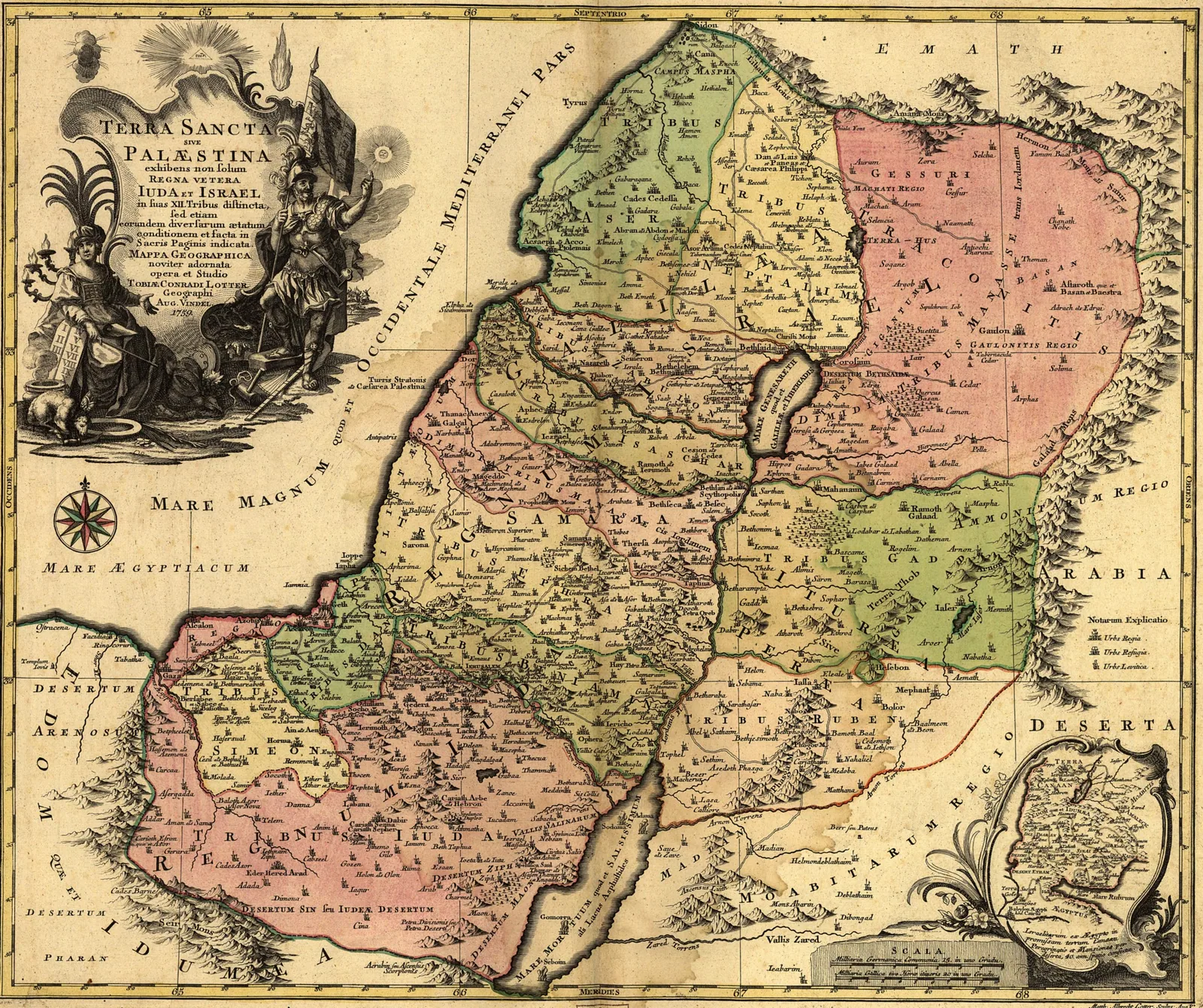
Divisions
The twelve sons comprise the Twelve Tribes of Israel. These tribes were recorded on the vestments of the Kohen (high priest). However, when the land of Israel was apportioned among the tribes in the days of Joshua, the Levite, being priests, did not receive land. Therefore, when the tribes are listed in reference to their receipt of land, as well as to their encampments during the 40 years of wandering in the desert, the Tribe of Joseph is replaced by the tribes of Ephraim and Manasseh (the two sons of Joseph by his Egyptian wife Asenath, whom Jacob elevated to the status of full tribes).
Thus, the two divisions of the tribes are:
| valign=top width=50% | | valign=top width=50% | |
The Northern Kingdom of Israel and the Ten Lost Tribes
According to the Hebrew Bible, after the civil war in the time of Solomon's son Rehoboam, ten tribes split off the United Monarchy to create the northern kingdom of Israel.
These were the nine landed tribes Tribe of Zebulun, Tribe of Issachar, Tribe of Asher, Tribe of Naphtali, Tribe of Dan, Tribe of Manasseh, Tribe of Ephraim, Tribe of Reuben and Tribe of Gad, and some of Levi which had no land allocation. The Bible makes no reference at this point to the tribe of Simeon, and we might conjecture the author had in mind that that tribe had already disappeared due to the Tribe of Simeon.
Kingdom of Judah, the southern kingdom, had Jerusalem as its capital and was led by King Rehoboam. It was populated by the tribes of Judah and Benjamin (and also some of Levi and remnants of Simeon).
In 722 BCE the Assyrian people under Shalmaneser V and then under Sargon II conquered the northern Kingdom of Israel, destroyed its capital Samaria and sent the Israelites into exile and captivity in Khorason, now part of eastern Iran and western Afghanistan. The Ten Lost Tribes are those who were deported. In Jewish popular culture, the ten tribes disappeared from history, leaving only the tribes of Tribe of Benjamin and Tribe of Judah and the Tribe of Levi who eventually became the modern day Jews. See also Bnai Israel.
Babylonian captivity
In 586 BCE the nation of Judah was conquered by Babylon. About 50 years later, in 539 BCE, the Persians (who had recently conquered Babylon) allowed Jews to return to Jerusalem and rebuild the Temple in Jerusalem. By the end of this era, members of the tribes seem to have abandoned their individual identities in favor of a common one.
Jews as Israelites
Whatever the historical origin of the Israelite tribes, each tribe had a distinct identity inherited from one's father as recently as 722 BCE, when the Assyrians conquered the northern Kingdom of Israel and sent its populace into exile. Individual tribes intermarried extensively throughout history. Many Israelites from the northern kingdom fled to the Southern Kingdom of Judah. At this point in time the tribes living in the Kingdom of Judah melded into a single people from all the Israelite tribes. In 586 BCE the nation of Judah was conquered by Babylon. About 50 years later, in 539 BCE the Persians (who conquered Babylon) allowed Jews to move back to Jerusalem. By the end of this era, members of the tribes seem to have abandoned their individual identities.
Jewish religious texts from the first century BCE to the present time consistently refer to Jews as "Yisrael", or "Israelites", rather than "Yehudi", the more specific Hebrew language term for "Jew". This usage was adopted in secular Jewish writing of Hungary in the 1920s and 1930s; Stephen Roth writes, "The word 'Israelite' denoted only religious affiliation and was free from the ethnic or national connotation attached to the word 'Jew', which History of the Jews in Hungary therefore regarded almost as a derogatory term."[1]
Today's Jews are mostly descended from the Hebrews of the Kingdom of Judah, as well as those who joined them via Giur and married with the descendants of the Judaic Hebrews.
References
References and notes
- Roth, 1992, 132
- Roth, Stephen, "Memories of Hungary", in Riff, Michael, The Face of Survival: Jewish Life in Eastern Europe Past and Present. Valentine Mithcell, London, 1992, 125-141, ISBN 0-85303-220-3.
Kasluchite Nation
The Targum renders this as Pentpoletai, most probably Pentapolis, an Egyptian district also called Cyrenaica. In the Midrash it is rendered Pekosim (Bereshith Rabbah 37). Saadia Gaon identifies it with Sa'id on the upper Nile.
Khushite-Chavilahite Nation
See note on Genesis 2:11. The Targum has India. Josephus, however, has Getuli.
Khushite-Shevaite Nation
Actually Sh'bha. See 1 Kings 10:1, Genesis 10:28, 25:3. Josephus identifies these with the Sabeans, as he does to S'bha. The Targum renders it Zamdugad, Zamrugad (on Genesis) or Zmargad and Dmargad (on Chronicles).
Kittite Nation
An island people; cf. Jeremiah 2:10, Ezekiel 27:6. Also see Numbers 24:24, Isaiah 23:1, 23:12, Daniel 11:30. Josephus identifies it with Cyprus, whose main city was Citius (cf. Abarbanel). The Targum, however identifies it with Italy (Italion, Italia), and hence, it is seen as the source of the Italian and Romans (cf. Targum on Numbers 24:24).
Lehavite Nation
Literally 'fire people,' since their faces are like fire (Rashi). The Targum translates this name as Livvakai or Livkai, possibly a Lybian tribe. Josephus states that they are Lybians. See note on Genesis 10:6 regarding Put.
Lotite Nation
The Moabites and Ammonites, descended from the two sons of Lot, are prominent in scriptural history. They lived more to the north than any of the nation's before specified. Their most southerly stations lay east of the Dead Sea, and comprised the fine pasture lands of Bilcaa and Kerek.
Ludite Nation
Josephus identifies this with Lydia, south of the Black Sea (see Herodotus 7:74).
Madaiite Nation
Ancestor of Medes (Josephus; Yerushalmi, Megillah 1:9). This is also the opinion of the Talmud (Yoma 10a, cf. Hagahoth Beth Chadash, Rabbenu Chananel ad loc; Eyn Yaakov ibid.). Another source translates Madai as Chamadai (Targum on 1 Chronicles 1:5), possibly referring to Hamadan, an ancient Medean capital. An ancient source states that Madai is to the west of Gomer and Magog, on the shores and the islands (Yov'loth 9:9). (See Herodotus 7:62).
Mashite Nation
In 1 Chronicles 1:17 it is Meshekh (see Genesis 10:2). Josephus identifies it with Charax Spanisi. Other sources state that it is the land in the area of Mount Mash in Mesopotamia, north of Netzivim (Kesseth HaSofer).
Mitzraite-Ludite Nation
The Targum renders this Givatai. This appears to be related to the name Gipt or Egypt, and also to the word Coptic, which denotes the ancient language of Egypt (cf. Megillah 18a, Sanhedrin 115a). Josephus, however, states that all the nations in this verse are unidentifiable.
Nachorian Nation
The children of Nachor, not including Terach.
Nachorite Nation
Utz and Butz, the sons of Nahor, Abraham's brother, were the ancestors of extensive tribes to the north of Arabia; and the Bible repeatedly refers to them in connexion with this locality
Naftuchite Nation
The Targum translates this as Pontsikhnai or Pantsekhyaanaei, probably denoting Pentaschoinos. This is a district in Egypt later referred to as Dodekaschoinos.
Ofirite Nation
The place from which King Solomon brought gold; 1 Kings 9:28, 10:11. Cf. Psalms 45:9, Isaiah 13:12. From the context, it is a place on the Arabian peninsula. Some identify it with El Ophir, a town in Oman. Josephus, however, identifies Ophir with Aurea Chersonesus, belonging to India (Antiquities 8:6:4). The Septuagint translates Ophir as Sophia, which is Coptic for India. There was indeed an ancient city known as Soupara or Ouppara in the vicinity of Goa on the western coast of India. Later authors identified Ophir with the New World (Rabbi Azzaria de Rossi, Meor Eynaim, Imrey Binah 11; David Gans, Nechmad VeNaim 3:75; Tzemach David 2:1533; Seder HaDoroth 5254).
Ovalite Nation
Some identify this with Avalitae on the Ethiopian Coast.
Pathrusite Nation
See Isaiah 11:11, Jeremiah 44:1, 44:15, Ezekiel 29:14, 30:14. The Targum translates it as Nasyotai or Gasyotai, denoting Casiotis, the district surrounding Mount Casius, east of Pelusium in Egypt. The Targum on 1 Chronicles 1:12 reverses the definition of Pathrusim and Casluchim. In the Midrash it is rendered as Parvitoth (Bereshith Rabbah 37).
Pelegian Nation
The children of Peleg, not including R'eu.
Philistine Nation
Pelishtim in Hebrew. These people lived on the shore of the Mediterranean between the Holy Land and Egypt (cf. Exodus 13:17).
Ra'amahite Nation
Usually transliterated Sabta. Josephus identifies this nation with the Astaborans. The Talmud identifies it with outer Takistan, see S'bha. The Targum renders it S'midai, Smadai or Samrai, a Cushite tribe, possibly the Sabrata of North Africa.
Reuian Nation
The children of R'eu, not including Serug.
Rifathite Nation
In 1 Chronicles 1:6, however, the reading is Diphath (cf. Rashi ad loc.). Josephus identifies these people with the Paphlagonians, an ancient people who lived on the Rifas River (see Kesseth HaSofer 113a. Cf. Herodotus 7:72; Iliad 2:851). Other sources identify it with Parkhvan, Parkvi or Parsvey (Targum Yonathan; Targum on 1 Chronicles 1:6), most probably Parkvi, a country in Northern Ariana (in Persia). Still others identify it with Chadiv or Hadiath (Yerushalmi, Megilla 1:9; Bereshith Rabbah 37). The correct reading is most probably Hadiyv, which is identified with Adiebena, a district in Assyria between the Lycus and Caprus rivers. Abarbanel identifies these people with the Etruscans, who settled in Italy, Venice and France.
Savtahite Nation
Usually transliterated Sabta. Josephus identifies this nation with the Astaborans. The Talmud identifies it with outer Takistan, see S'bha. The Targum renders it S'midai, Smadai or Samrai, a Cushite tribe, possibly the Sabrata of North Africa.